Competitor Backlink Gap Analysis: How to Find Link Opportunities

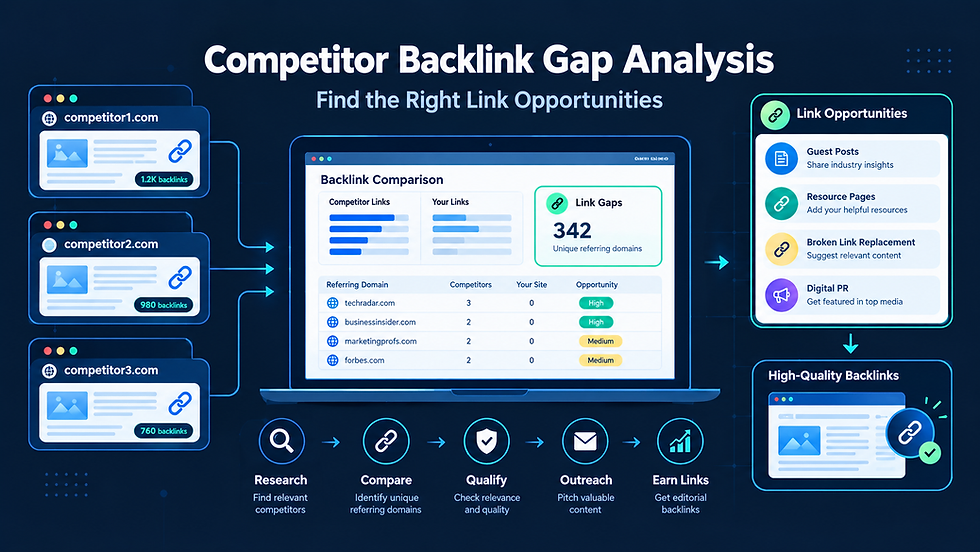
You have published useful content, improved your technical setup, and optimized your pages, yet you still watch direct competitors capture the top rankings you want. One reason for this gap is simple: they have links from authoritative websites that do not link to you. Instead of guessing where to build authority next, Link Building Services can help turn raw competitor data into a actionable, focused outreach strategy. Even if you manage campaigns yourself, analyzing link gaps reveals exactly where realistic opportunities exist.
What Is a Competitor Backlink Gap?
A competitor backlink gap represents the difference between websites pointing to your competitors and those linking to your own domain.
Suppose three competing brands in your niche maintain editorial references from the same industry journal, while your domain has none. That journal represents a backlink gap. It is not automatically a destination you must replicate, but it serves as a vetted, high-value prospect for outreach.
The central question in link analysis is not simply, "How many backlinks does my competitor have?" Rather, it is: "Which relevant publishers already cite businesses like mine, and what value proposition earned those placements?"
Step 1: Identify True Search Competitors
Analyzing the largest enterprise brand in your industry often yields misleading data. Market leaders frequently possess years of legacy press coverage, viral brand recognition, and unearned natural mentions that are difficult for smaller websites to replicate.
Instead, select three to five competitors that consistently rank for the specific search terms you target.
Look for sites that:
Focus on an audience identical to your prospective buyers.
Regularly publish content in your core topic areas.
Rank on page one for your target commercial keywords.
Possess a backlink profile built through active digital marketing.
Your primary goal is identifying comparable competitors whose link-acquisition strategies align with your current resources.
Step 2: Compare Referring Domains over Total Links
A single external domain might link to a competitor dozens of times across various site-wide footers or sidebar widgets. However, multiple links from a single source offer diminishing SEO returns compared to acquiring links from distinct domains.
Shift your focus toward unique referring domains. Utilizing dedicated backlink research platforms, compare your domain directly against your selected competitor set. Filter the results to display unique domains linking to two or more of your competitors, but not to your site.
When a publisher links to multiple industry peers, they demonstrate a clear interest in your market. These intersecting domains form the core foundation of your outreach prospect list.
Step 3: Analyze the Intent Behind Every Placement
Once you isolate a shared referring domain, examine the specific page hosting the competitor's link to determine why it was placed.
Common placement contexts include:
Resource Citations: The competitor provided primary research, data points, or unique statistics.
Expert Quotes: An executive contributed commentary to an industry news piece.
Resource Directories: The business was curated within a useful list of tools or service providers.
Guest Contributions: The competitor authored a guest article addressing a specialized topic.
Understanding the origin of a link dictates your outreach strategy. If a competitor earned an editorial citation by providing an original benchmark study, a basic outreach email asking for a link replacement will fail. You must first develop a comparable or superior resource that adds tangible value to the publisher's existing page.
For a deeper look into research tactics and link replication workflows, review this comprehensive guide on competitor backlink analysis.
Step 4: Qualify Opportunities Prior to Outreach
A competitor backlink serves as a prospect lead, not an automatic endorsement. Blindly replicating every link your competitors hold can introduce low-quality or unnatural signals into your backlink profile.
Evaluate prospective domains using a strict qualification framework:
Topical Relevance: Does the site's primary topic align with your niche?
Audience Match: Would actual human readers on this site find your content useful?
Editorial Quality: Is the content well-researched, original, and free of spam?
Organic Health: Does the site maintain consistent search engine visibility and traffic?
If a domain fails these checks, discard it. Filtering prospects early prevents wasting time pursuing placements that yield no real search equity.
Step 5: Convert Link Gaps into Categorized Campaigns
Group your qualified prospects by outreach type to streamline your messaging:
Editorial Citations: Pitch updated statistics, fresh infographics, or deeper technical data to replace or complement existing citations.
Guest Publications: Pitch original, gap-filling article ideas that match the publisher's editorial guidelines.
Resource Lists: Highlight broken links or outdated references on curation pages, offering your relevant resource as a modern replacement.
Categorizing prospects allows you to personalize communication at scale, raising response rates among editors and webmasters.
How Link Building Packages Accelerate Execution
Manual gap analysis, domain qualification, content production, and outreach management demand significant time and operational overhead.
Investing in structured Link Building Packages can help scale these processes efficiently. When evaluating service packages, prioritize transparent workflows over raw link volume metrics.
Ensure your provider incorporates:
Granular competitor gap identification.
Strict quality filters for domain authority and organic traffic.
Custom, non-templated editorial outreach.
Professionally written, topically aligned content assets.
Transparent live-link reporting with clear anchor text tracking.
Avoid packages promising massive link quantities for unsustainable prices, as these often rely on automated link networks that expose your domain to algorithmic penalties.
Common Backlink Gap Errors to Avoid
Avoid these frequent mistakes when conducting gap analysis campaigns:
Blind Replication: Attempting to copy every link without checking quality can ruin your domain authority.
Over-Emphasizing Third-Party Metrics: Selecting targets based solely on synthetic domain scores rather than topical relevance leads to poor link signals.
Generic Outreach Emailing: Mass-blasting generic pitches damages publisher relationships and drops response rates.
Promoting Low-Value Pages: Attempting to build links to thin or poorly formatted content makes outreach ineffective. Build high-value content assets first.
Tracking and Measuring Campaign Success
Organize your campaign using a dedicated tracking spreadsheet to record outreach progress and live placements.
Track the following key variables:
Target Referring Domain & Specific Target Page
Category Type (Resource, Guest Post, Citation)
Contact Information & Outreach Sent Date
Response Status & Live URL
Judge campaign performance beyond total links acquired. Monitor the growth of unique referring domains, organic referral traffic, target page indexing speed, and long-term keyword ranking movements for your core commercial URLs.
Competitor Backlink Gap Checklist
Before launching your outreach workflow, confirm these essential steps:
Identified 3 to 5 realistic search competitors.
Isolated unique referring domains linking to multiple competitors.
Qualified domains for real organic traffic and topical relevance.
Determined the specific reason behind each target placement.
Developed high-value content assets ready for referencing.
Drafted personalized outreach messages tailored to each category.
Configured tracking metrics to measure long-term link performance.
Frequently Asked Questions
What is the primary benefit of competitor backlink analysis?
It provides a proven blueprint of websites already interested in your industry, eliminating guesswork and helping you secure high-converting, contextually relevant backlinks.
How often should a website conduct a backlink gap analysis?
Conduct a comprehensive analysis quarterly. Search results fluctuate constantly as competitors earn new links and publishers update legacy content.
Can a new website replicate backlinks from established competitors?
Yes, provided you target realistic search competitors rather than enterprise market leaders, and offer fresh content that fills noticeable gaps.
Are paid SEO tools mandatory for gap analysis?
While specialized SEO tools significantly speed up domain matching and link history extraction, manual evaluation of competitor ranking pages remains necessary to verify placement quality.
Conclusion
Competitor backlink gap analysis converts abstract ranking challenges into an actionable roadmap. By identifying overlap among competitor domains, analyzing why links were awarded, and delivering superior value to target publishers, you can systematically close the authority gap. Focus on securing relevant, editorially earned links to build lasting search visibility and sustainable organic traffic growth.



Comments